
Built to Learn ASL and Create Connections.
Access isn’t just about getting the captions, it’s about receiving a complete signal.
Beyond the Check Box
Traditionally, access has been treated as a technical checkbox. Systems provide the information captions at the bottom of the screen or a tiny, clinical box in the corner, but they often miss the human aspect. This bolted-on approach creates cognitive fatigue, forcing a deaf person to choose between watching the story or watching the sign or caption. It provides the words, but it fails to provide the connection.
“It takes a village…”
– African Proverb
…to build a bridge that actually holds weight. Accessibility shouldn’t be an afterthought; it should be included as part of the substrate.
Zamoh Solutions
For Parental Islands
90% of Deaf children are born to hearing parents. Zamoh provides a low-friction environment where families don’t just learn a utility they learn a shared language of connection.
For Representation Void
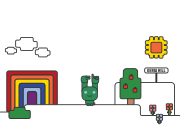
Inclusion isn’t just about language; it’s about Legacy. Through the modular world of Geria Hill, diverse characters, ensuring every child sees themselves in the laboratory of life.
For Literacy Barriers
Captions require high-speed reading levels that children ages 2–8 haven’t mastered yet. Zomah provides visual-first data, ensuring science is accessible before the first book is even opened.